



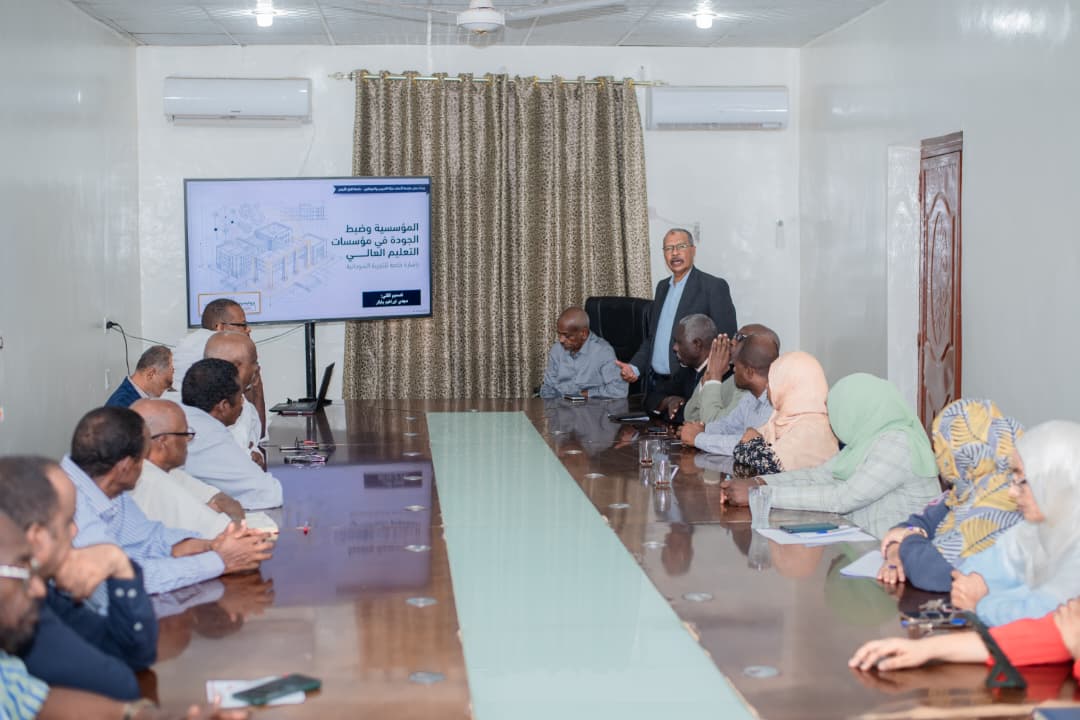
Professor Al-Shadhli Eissa Hamad, Vice-Chancellor of White Nile University, emphasized the importance of adhering to the university's administrative and institutional structures, stressing the necessity of applying the rules and regulations that govern academic and administrative work in higher education institutions.
This came during his address at the workshop titled "Institutionalism and Quality Control in Higher Education Institutions: The Sudanese Context," organized by the Deanship of Quality, Evaluation, and Accreditation at the university. The workshop was presented by Professor Awad Hajj Ali, computer and information technology expert and scientific research advisor at the university, in the presence of Dr. Qamar Al-Dawla Abdul-Muttalib Ahmed (Deputy Vice-Chancellor), Dr. Bishara Eissa Hamad (Academic Affairs Secretary), Dr. Essam El-Din Ahmed Mohamed Badri (University Bursar/Registrar), and Professor Mohamed Al-Amin Mohamed Yousif Kabar (Dean of Quality, Evaluation, and Accreditation).
The workshop targeted university faculty and staff members. Professor Al-Shadhli stated that the university is moving on the right track by following the principles and regulations governing higher education institutions issued by the Ministry of Higher Education and Scientific Research. He explained that the university has internal laws and regulations that clearly define the duties and responsibilities of each administrative entity and unit. Reaffirming the university administration's commitment to implementing the recommendations emerging from the workshop, he noted that the university pays great attention to organizing workshops and training courses for its teaching staff and employees to achieve its goals of capacity building and enhancing professional competence. He added that the university recently organized several specialized training programs, the latest of which was a dairy products workshop presented by Professor Ibtisam Elias Mohamed Al-Zubair, an expert in animal and plant production.
Meanwhile, Professor Awad Hajj Ali reviewed the administrative hierarchy in higher education institutions, detailing the duties and responsibilities of each administrative level while stressing the importance of adhering to institutionalism and applying quality standards across various academic and administrative procedures and operations. He highlighted that the student is the primary focus of the educational process, being the chief beneficiary of quality outcomes. He also addressed the roles of the college dean, department head, and lecturer in achieving academic objectives. Additionally, he presented several proposals for developing administrative systems and organizational structures. These included establishing an accreditation and quality control board to work in coordination with the relevant authorities at the Ministry of Higher Education, ensuring clarity in reports submitted to pertinent bodies, adhering to measurement and quality standards, and implementing merit-based hiring while embedding principles of competition and transparency in higher education institutions.